Insights / Averane perspective
Your Marketing Report Says It’s Working. Are the Right Customers Reaching Out?
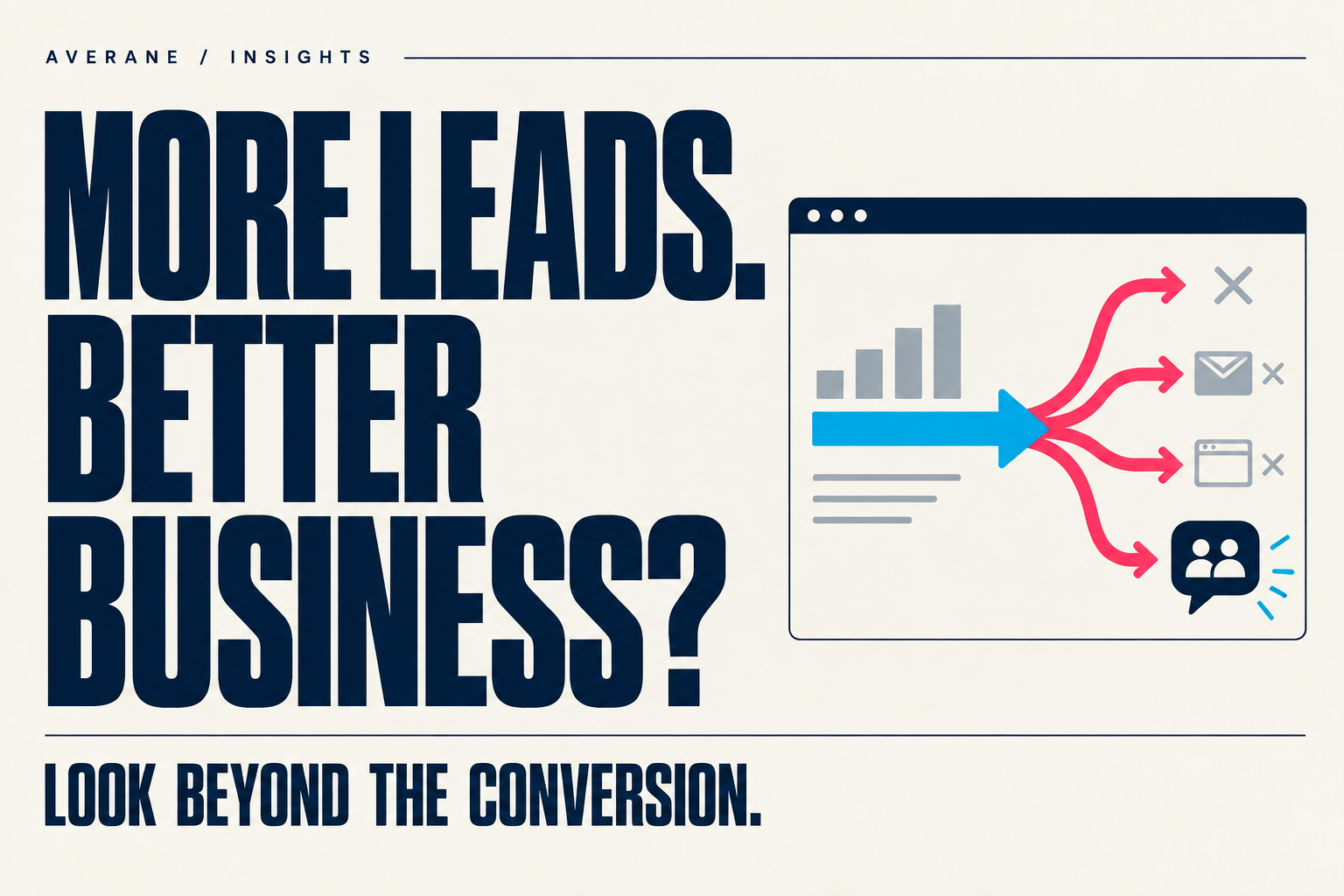
The report looks healthy. Traffic is up. The campaign has generated conversions. The cost per lead has fallen. Yet the people answering the phone are telling a different story: more unsuitable requests, more time spent clarifying what the business does, and fewer conversations that become worthwhile work.
Both accounts can be accurate. Marketing may be generating the action it was asked to generate. The business may need a different action, a different customer, or a better way to connect that first response to what happens next.
For a service business, a form submission is the beginning of an investigation. It tells you that somebody reached out. It does not establish that the person needs your service, can be served in your location, is ready to proceed, or will become a customer. A report becomes useful when those distinctions are visible.
This guide explains how to measure website lead quality, where apparently successful campaigns can lose their connection to business outcomes, and how to decide what to improve. It is written for owners, marketing teams and the people who handle inquiries. The principles also apply to longer sales cycles, although the stages and review periods need to reflect how your business actually operates.
What does lead quality actually mean?
Lead quality is the suitability of an inquiry for the service your business provides, assessed against explicit criteria and followed through to an outcome. Those criteria might include the need, service area, project scope, realistic timing and whether a useful next conversation is possible.
Quality is contextual. An excellent inquiry for one business may be unsuitable for another. A customer seeking a small repair could be ideal for a maintenance company and outside the scope of a specialist that only undertakes full installations. Neither customer is inherently a “bad lead.” The match is different.
The practical question is therefore: are we attracting people we can help, and are we giving those people a credible path from interest to a useful conversation?
Define suitability before comparing campaigns. Otherwise, the meaning of “qualified” can change depending on who is reporting, which month is being discussed, or whether the numbers look encouraging. Keep the definition short enough that two colleagues can apply it consistently to the same inquiry.
Separate the stages before you count them
A single column called “leads” often contains several different things. A button click, a successful submission, a real inquiry and a sales opportunity are different observations. Combining them makes the total larger while making its meaning less clear.
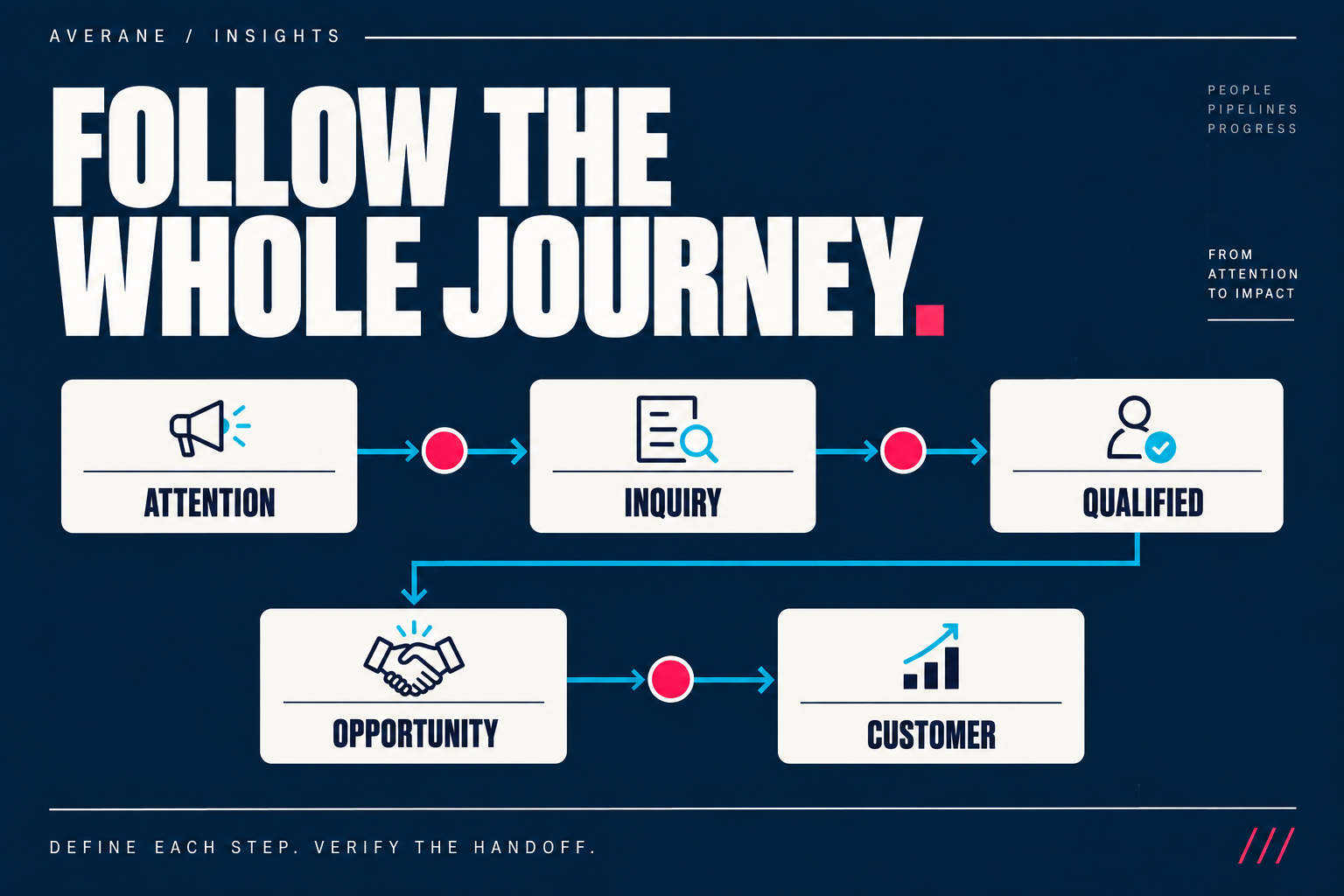
Attention
A person encounters your business through an advertisement, search result, referral, social post or another channel. Visits and engagement can help explain discovery. They do not establish suitability or buying intent.
Inquiry
A person submits a request, makes a relevant call, sends an email or otherwise asks for a conversation. Decide what counts as a valid inquiry. Exclude spam and tests from the commercial total, and identify duplicates without deleting the evidence needed to understand repeat contact.
Qualified inquiry
You have enough information to establish that the request meets your agreed suitability criteria. An inquiry awaiting clarification belongs in a pending or unknown category. It should not automatically be treated as unsuitable because somebody has not answered yet.
Opportunity
There is a credible commercial next step, such as a scoped meeting, assessment, proposal or estimate. Define the milestone your team actually uses. A booked conversation and a proposal issued are not interchangeable.
Customer
The business has reached its agreed customer milestone, such as a signed agreement or completed purchase. Keep projected value, contracted value, collected revenue and profit separate. A large proposal is not money received.
Google’s recommended Analytics events distinguish lead generation from qualification and later lead outcomes. These are implementation options, rather than stages that automatically appear because a website uses Analytics. Your tracking needs to reflect the process your team has defined.
Terms such as marketing-qualified lead and sales-qualified lead can be helpful when responsibilities are clear. Write down what each means locally. A familiar abbreviation does not create a shared definition by itself.
Agree what a suitable inquiry looks like
Start with the questions that affect whether your business can help. Avoid building a scoring system merely because a dashboard can display one. A small business may learn more from five clear criteria and a reason code than from a complicated score nobody trusts.
• Service fit: Is the person asking for work you actually provide?
• Location fit: Can you serve the place where the work is needed?
• Scope fit: Is the request within the kinds and sizes of projects you undertake?
• Readiness: Does the timing support a useful next step, or is this an earlier research conversation?
• Practical fit: Are there relevant constraints, permissions or investment expectations that need clarification?
Only collect information that serves a real purpose. If investment level matters, explain why you are asking and offer a sensible “not sure yet” answer. If a customer cannot reasonably know the technical scope, help them describe the problem instead of making expertise a condition of contacting you.
Use categories that support decisions: suitable, unsuitable, pending clarification, spam or test, and duplicate are a workable starting point. Record the reason for an unsuitable inquiry. “Wrong service” points to a different improvement from “outside service area.” Keep early-stage interest separate from definitive rejection if it may become relevant later.
Review a handful of real inquiries together. If colleagues disagree, refine the rule and record the uncertainty. Qualification should help you understand the match, not turn incomplete information into confident labels.
Measure the relationship between volume, quality and outcomes
You need several measures because each answers a different question. State the date range, source of the records and denominator alongside every rate. A percentage without its underlying count can make a very small sample look more persuasive than it is.
Valid inquiry volume
Count unique, genuine inquiries using your agreed rules. Keep gross submissions visible as an operational measure, then show the exclusions. If fifty submissions become thirty valid inquiries, the difference deserves an explanation: duplicates, spam, tests or another recorded reason.
Qualification rate
Qualification rate = qualified inquiries ÷ the stated inquiry denominator × 100. For a cohort of forty valid inquiries with sixteen qualified, the rate is 40%. Show how many remain pending. If you also calculate a rate among assessed inquiries, label it separately; changing the denominator changes the interpretation.
Cost per qualified inquiry
Cost per qualified inquiry = the included marketing cost ÷ qualified inquiries. Specify whether the numerator contains media spend only or also includes agency fees, creative production and other costs. Compare like with like. A media-only figure cannot fairly be compared with a fully loaded cost.
Progression and customer outcomes
Track how qualified inquiries become opportunities and customers, using the same starting cohort. Record lost and pending outcomes as well as successful ones. Where reliable data exists, connect customer value to the cohort. Keep revenue-based returns distinct from margin and cash collection.
Response and handling
Measure the time to a first useful response and the proportion of inquiries with a recorded next step. An automatic receipt is helpful, but it is a different event from a person providing a relevant answer. Define business hours and the start and end timestamps before comparing response times.
These measures work together. A higher qualification rate can still produce too few opportunities. A larger number of qualified inquiries can still overwhelm the team. A low acquisition cost can still be unattractive if the resulting work has poor margins or does not fit the business’s direction.
A cheaper lead can cost more to turn into useful work
Consider two hypothetical campaigns over comparable periods. Assume that all inquiries shown are valid, the qualification definition is identical and both cohorts have had enough time to be assessed.
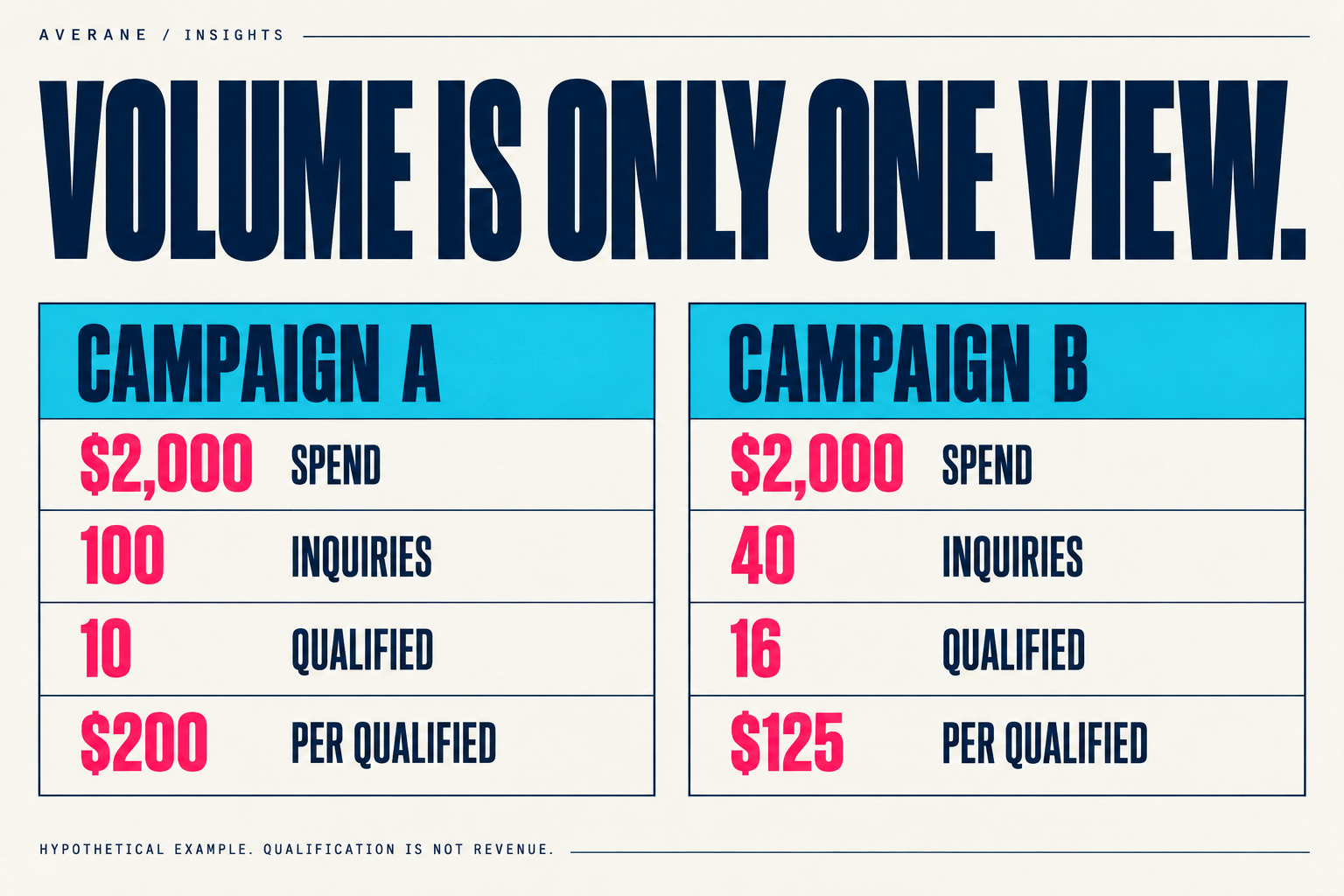
Campaign A spends $2,000 and generates 100 inquiries. Ten qualify. Its media cost is $20 per inquiry and $200 per qualified inquiry, with a 10% qualification rate.
Campaign B spends $2,000 and generates 40 inquiries. Sixteen qualify. Its media cost is $50 per inquiry and $125 per qualified inquiry, with a 40% qualification rate.
If the report stops at cost per inquiry, A looks stronger. If the immediate objective is obtaining suitable conversations, B produces more of them at a lower media cost per qualified inquiry.
That does not establish B as the better business investment. We have not examined customer conversion, revenue, margin, capacity or the time required to handle each inquiry. We also do not know how representative these periods are. Qualification is a more useful intermediate signal, but it remains an intermediate signal.
The decision is to investigate the next stage with the same discipline. Follow both cohorts through the sales process. Establish whether differences persist, whether the work suits the business and whether costs are defined consistently. Avoid selecting a winner from whichever metric happens to support the preferred story.
Check the promise before you change the form
Unsuitable inquiries can start well before a visitor reaches the contact page. The advertisement may imply a service you do not offer. A search result may land on a broad page that hides a crucial limitation. A campaign may attract people looking for advice when its objective assumes they are ready to purchase.
Trace a real inquiry back through the journey where evidence is available. What did the customer see? What were they likely to expect? What did the destination page confirm or leave ambiguous? Read the advertisement and page together, rather than reviewing each in isolation.
Google’s landing-page guidance emphasizes alignment between an advertisement and its destination, useful content and a clear next action. Apply that principle to suitability as well as conversion: the promise should help the right visitor recognize the offer.
Useful clarifications might include the service area, the kind of work undertaken, who the service is designed for, typical next steps and what a consultation covers. Include relevant proof that helps a visitor judge the fit. Make those details readable on mobile and place important limitations where people make decisions.
A qualification field cannot fully repair an unclear offer. Asking somebody to select a project type is useful only if the available choices make sense and the surrounding page explains what your business does. Review the message, audience and destination before introducing additional steps.
Averane’s digital marketing services connect campaign work with measurement and conversion improvement. Our web design approach addresses the experience that follows the click. Lead quality often depends on how those parts work together.
Use qualification to help people make a decision
A form should gather enough information to support the next step without making visitors perform unnecessary work. More fields are not automatically better qualification. Fewer fields are not automatically better conversion. The useful question is what each field allows the team to do that it could not otherwise do.
A service-area check can prevent a customer spending time on an unavailable service. A short description of the problem can help route an inquiry. A choice of contact preference can make the first response more practical. A mandatory technical questionnaire may exclude suitable customers who need your expertise precisely because they cannot diagnose the problem.
Explain the purpose of consequential questions. Give clear labels, usable error messages and a confirmation that states what happens next. The W3C’s guidance on form notifications explains how to communicate successful submission and errors accessibly.
Test the experience with realistic requests on a phone as well as a desktop. Include someone who does not know your internal terminology. Check whether the form can be completed with a keyboard and whether errors are understandable. Inspect the resulting record, not just the visual success message.
Our insight on making effort meaningful in web design explores this distinction: a step should help the user or improve the outcome. Difficulty introduced without a clear purpose is simply another reason to leave.
A suitable inquiry can still disappear in the handoff
Marketing can attract the right person and the website can capture the right information, while the business still loses the opportunity. The request may arrive in an unmonitored inbox, reach the wrong team, lack enough context for a useful reply or remain untouched because ownership is unclear.
Follow a test inquiry end to end. Confirm that the submission creates the intended record, reaches the responsible person and preserves the information needed to respond. Check integrations, notification rules, spam folders and alternative routes such as calls and direct email. A receipt page proves only the behavior that page actually verifies.
Agree who owns a new inquiry, who covers absences, what a useful initial response should contain and when an unanswered inquiry is reviewed. Set expectations you can keep. A clear statement of the next step is more helpful than an ambitious response promise the team routinely misses.
Record contact attempts and outcomes with proportionate detail. Distinguish “could not reach” from “not suitable.” A person who has not replied may still fit the service. Do not attribute every lost opportunity to lead quality when the evidence points to handling, timing, pricing or availability.
When forms, notifications or integrations need ongoing attention, website support helps maintain the journey after launch. Measurement is more valuable when the path it measures continues to function.
Make the tracking agree with the thing you mean
A tracking event is a record of an implemented trigger. Its label does not guarantee that the real-world event happened. A conversion named “lead” might fire when somebody clicks a button, opens a form or reaches a confirmation page. Establish what actually causes it to fire.
Test a successful submission, a failed submission, a repeat visit to the confirmation page and a duplicate request. Check whether events occur once when intended. Confirm which actions are included in reporting and campaign optimization. A diagnostic interaction can be useful to measure without being treated as equivalent to a qualified inquiry.
Use your operational inquiry records as the place to reconcile the business stages. Analytics can explain behavior and acquisition; a CRM or consistent inquiry register can record assessment and outcomes. Neither should be expected to reproduce the other perfectly when their units, attribution rules or collection methods differ.
Google Ads supports qualified and converted lead goals associated with later outcomes. If you use such feedback, check the supported implementation, matching requirements and the completeness of your records. Do not enable an outcome simply because its label sounds closer to revenue.
Use a durable internal record identifier where appropriate, preserve the original inquiry date and record status changes. Document the channel assignment method. Do not silently replace an unknown source with the channel you assume was responsible.
Keep personal details in the systems designed to handle them. Google’s Analytics guidance on avoiding personally identifiable information is relevant when configuring URLs and event data. Names, email addresses and free-text customer messages should not accidentally enter ordinary Analytics parameters.
Consent choices, blocking, platform modeling, offline contact and cross-device journeys can leave gaps. State those limits. “Unattributed” is useful information about the measurement system; it is not proof that the inquiry had no marketing influence.
Compare cohorts that have had time to develop
An inquiry cohort is a group defined by when inquiries began, often with another shared characteristic such as campaign or service. Following that group over time allows you to see how its requests progress. It avoids comparing this month’s new inquiries with this month’s customers when those customers first contacted you much earlier.
Choose review windows that reflect the sales cycle. A business that closes work within days can assess progress sooner than one that quotes complex projects over several months. Show pending opportunities rather than treating every unclosed request as a failure.
For example, report inquiries received in September, their qualification status as of a stated October date, and their later customer outcomes when enough time has elapsed. Keep the snapshot date visible. An early view and a mature view of the same cohort answer different questions.
For small volumes, show counts and inspect the records. One additional customer can move a percentage dramatically. Avoid declaring a trend from a handful of inquiries or applying a benchmark from a business with a different service, audience, price or sales cycle.
Compare like periods where possible, while noting changes in spending, availability, seasonality, offers and routing. If a campaign change and a new sales process happen together, the resulting improvement cannot automatically be credited to one of them.
Attribution explains credit. It does not prove cause.
Attribution distributes credit according to a chosen approach and the data available. Google’s Analytics attribution documentation explains how credit can be assigned across touchpoints. Use the chosen model consistently and identify it when presenting channel results.
A customer might discover you through search, return after a referral and then click an advertisement before contacting you. Different reports can credit different parts of that journey. That does not necessarily make either report broken.
The separate question is whether the activity created additional suitable demand. Answering that requires stronger evidence than a credited conversion alone. Depending on your volume and circumstances, a controlled experiment may help. With smaller samples, combine the available data with inquiry review and carefully bounded tests, and state what remains uncertain.
Ask customers how they found you where it is useful, but treat self-reported answers as another source of evidence. People may remember the most recent touchpoint or summarize a longer journey. Their answer can illuminate context without functioning as a perfect tracking substitute.
Turn the report into decisions
A useful report should make the next action clearer. Show the counts, costs, suitability reasons, handoff performance and outcomes together. Then identify which part of the journey the evidence suggests examining.
• Many wrong-service inquiries: review advertisements, search intent, page titles and the description of what you provide.
• Many out-of-area requests: review geographic targeting and where the service area is explained.
• Suitable inquiries with slow responses: review ownership, notifications, coverage and the first-response process.
• Qualified conversations that rarely progress: examine expectations, scope, capacity, pricing and the quality of the next step.
• Healthy sales records with unexpectedly weak tracking: inspect event triggers, source capture and reporting definitions.
• Lots of pending or unknown records: improve assessment and follow-up before making strong claims about quality.
These are investigation paths, not automatic diagnoses. Read examples from the underlying records and speak with the team handling the requests. A pattern in a dashboard can point you toward a question; it does not explain the whole answer.
If the evidence suggests the website itself needs attention, start with our guide to diagnosing a website before redesigning it. A broad rebuild should follow an identified need. A clearer page, repaired integration or more reliable handoff may address a specific problem sooner.
A practical lead-quality review worksheet
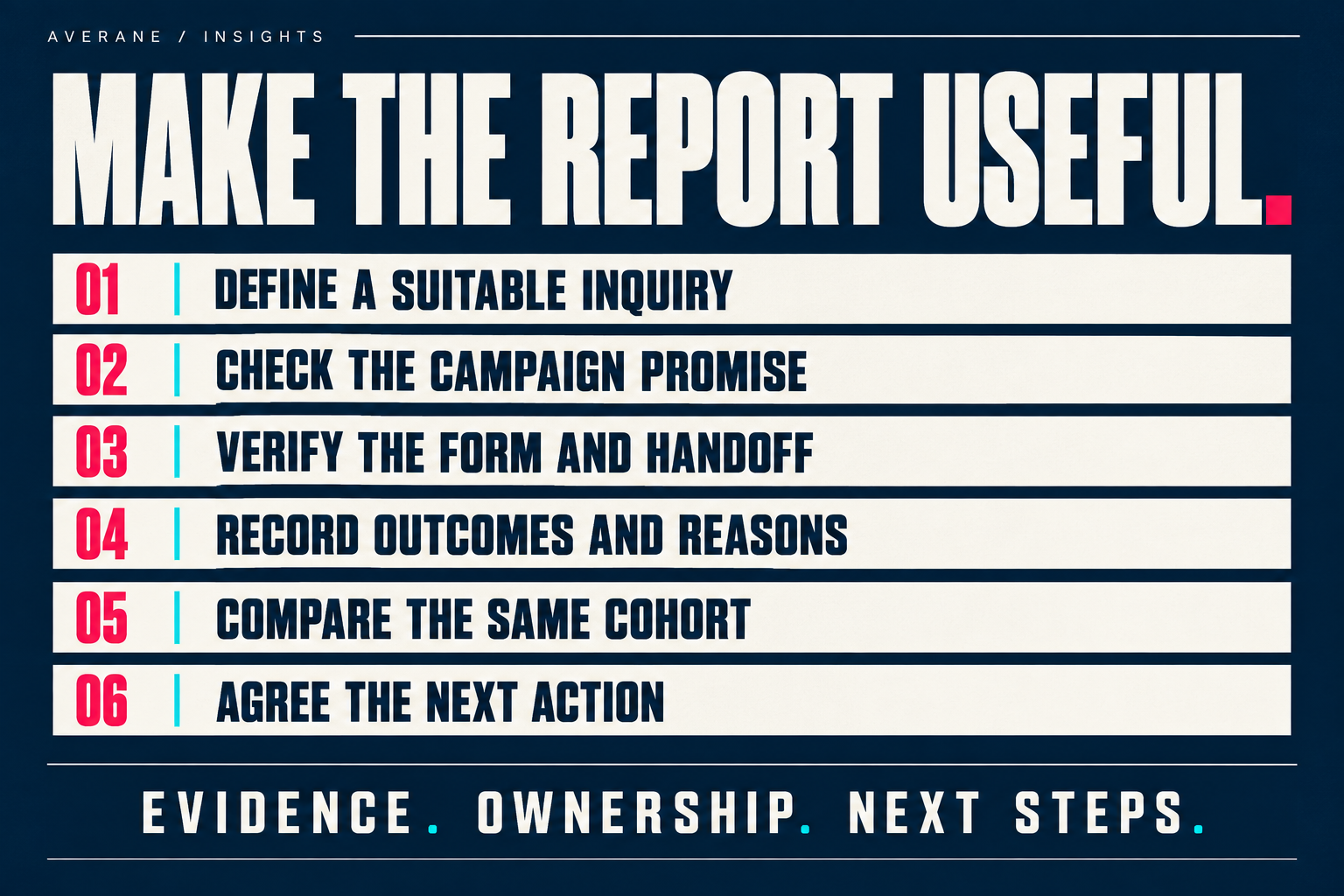
Use this as a shared brief for the person responsible for marketing and the person responsible for responding. A simple, consistently maintained document can be enough to begin.
• Purpose: Which service and customer outcome are we trying to support? What work can the team realistically take on?
• Definitions: What counts as a valid inquiry, qualified inquiry, opportunity and customer? How are duplicates, spam and pending assessments shown?
• Cohort: When did these inquiries begin, which channels or campaigns are included, and when was the status snapshot taken?
• Evidence: What are the counts at each stage, the stated denominators, included costs, response times and main reasons for disqualification or loss?
• Reliability: Which records are incomplete, how are sources assigned, and what tracking or integration limitations affect the comparison?
• Action: What will change, who owns it, what outcome should improve and when will the same measures be reviewed?
Keep a short change log. When targeting, copy, a form or a handling rule changes, record the date and intent. That context makes later results easier to interpret and prevents a team from repeating a test without remembering what it learned.
Your first 30 days: establish a dependable baseline
Thirty days can be a useful period for improving the process. It is not a promise that every business will have enough mature sales outcomes to judge campaign performance in that time.
Week 1: define and inspect
Agree the stages and suitability criteria. Review a manageable sample of recent inquiries with the people who handled them. Identify unknowns and write down the current source and cost definitions. Choose one service or journey if the whole business is too broad to assess consistently.
Week 2: verify the journey
Test the campaign destination, form, confirmation, notification and record creation. Check the real trigger behind each important conversion. Repair obvious failures and document them so later results are not compared as if nothing changed.
Week 3: record consistently
Apply the agreed statuses and reason codes to new inquiries. Confirm ownership and coverage. Review unclear cases together and improve the definitions where necessary. Keep pending information visible rather than forcing a completed outcome.
Week 4: choose a focused improvement
Review the baseline with its limitations. Select an action supported by the evidence: a clearer offer, a corrected service-area message, a routing repair or a better first response. State what you expect to change and schedule a review that allows the inquiry cohort time to progress.
Averane’s connected process brings strategy, design, development and ongoing care into the same conversation. That is useful here because the problem may sit between teams rather than inside one isolated channel.
Questions businesses ask about lead quality
What is a good qualification rate?
There is no universal target that establishes success for every service business. Begin with a consistent definition, a reliable baseline and enough context to interpret the count. Judge changes alongside opportunity volume, customer outcomes, cost and capacity.
Should we aim for fewer inquiries?
Fewer inquiries are not the objective by themselves. The goal is sufficient suitable demand that the business can serve well. Better clarity may reduce unsuitable requests while improving useful conversations; monitor both effects rather than celebrating a smaller inbox.
Can we measure this without a CRM?
Yes. A securely managed inquiry register with consistent identifiers, dates, statuses, sources and reasons can establish a baseline. A CRM becomes valuable when volume, ownership or integration requirements make that approach difficult to maintain. Choose a system the team will actually use.
Why do advertising and sales totals disagree?
They may count different events, use different attribution rules, cover different date ranges or include duplicates and modeled activity differently. Compare definitions and individual records where appropriate before deciding a system is wrong. Report the unresolved difference explicitly.
Should every campaign optimize for qualified leads?
Use a goal that fits the campaign’s role and the reliability of the available feedback. Later-stage outcomes can be valuable signals, but incomplete, inconsistent or very sparse records may not support the change you intend. Review the platform requirements and measure the effect rather than assuming a new goal label will improve results.
How quickly will better qualification improve revenue?
That depends on the sales cycle, the underlying issue, the volume of inquiries and the business’s ability to convert and deliver the work. Early improvements may appear in clarity or handling before revenue. Follow the same cohorts long enough to see the later outcomes.
Make success mean something to the business
Traffic, clicks and form submissions are useful signals when you know what they represent. Their value increases when you can connect them to suitable inquiries, reliable responses and customer outcomes.
The next conversation about your marketing should therefore include the people receiving the requests. Agree what a worthwhile inquiry looks like. Inspect the promise and the handoff. Record what happens next. Then choose the improvement the evidence supports.
If your report and your team are telling different stories, Averane can help examine the journey between them. Book a consultation to discuss your campaigns, website and inquiry process, and identify where a clearer connection would make the greatest difference.